The engagement entry lasts about thirty seconds. The bride steps through a doorway, usually with her mother beside her, and walks toward a room full of people who have all turned to look at her. It cannot be repeated and it cannot be staged afterwards. Handled well, it produces the single image most families end up framing. This guide covers how that moment is actually photographed - the timing, the light, the framing, and the small planning decisions that decide whether it works.
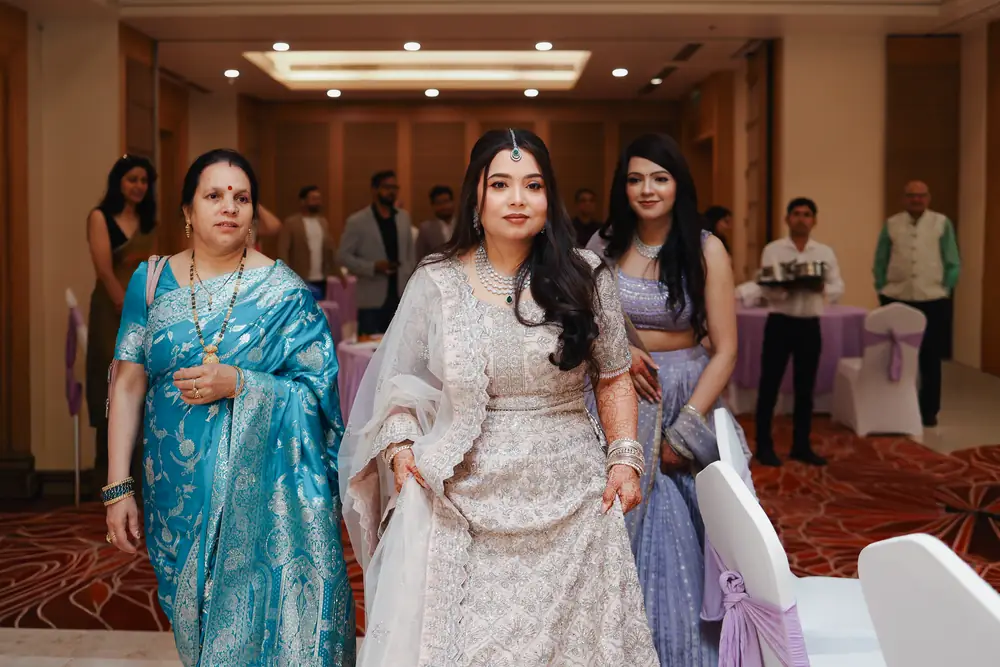
Look at the photograph above. The bride is centre frame, but the picture is not really about her outfit. It is about the woman walking beside her in the blue Banarasi saree - one step behind and slightly to the side, present, watchful, letting her daughter go first.
That is what makes an entry frame worth planning for. A portrait of the bride can be taken at any point in the evening, in better light, with more time. The entry cannot. It is the only moment of the function where the bride, her mother, the room and the occasion are all in one frame at once, unrehearsed.
Three things need to be known before the bride steps out, and none of them can be worked out on the spot.
The route. Which doorway, which direction, where she stops. A photographer walking backwards ahead of the bride cannot be discovering the path at the same time.
The pace. A slow, unhurried walk gives roughly three times as many usable frames as a fast one. This is worth saying to the bride once, quietly, before she enters - not shouted mid-walk.
The stop. A brief, natural pause a few steps in - not a pose, just a moment of standing still - is where the strongest frame almost always comes from. It gives everyone a beat to look up, and it gives the camera a clean, still subject.
Most engagements in Lucknow happen indoors, in hotel banquet halls lit by warm ceiling downlights. That light falls vertically, which flatters almost nothing - it leaves shadows under the eyes and drains the detail out of heavy embroidery.
The working solution is a soft light source placed slightly to one side and just above eye level, held at low power, mixed with the room's existing warmth rather than overpowering it. Done properly, faces are evenly lit, the silver work on the lehenga still catches light, and the hall behind still looks like a warm room rather than a white box.
Direct, full-power on-camera flash does the opposite. It flattens the outfit, kills the background and makes an expensive lehenga look like a snapshot. When reviewing a studio's engagement work, look specifically at whether the background of their entry shots still has depth and colour.
The entry is one of the few moments where a second photographer pays for itself immediately.
One person moves backwards ahead of the bride, holding her and her mother in frame as they approach. The second stays still near the stage, pointed the other way - at the faces of the family watching her arrive. Those reaction frames, her father seeing her, a grandmother's expression, are frequently the images families respond to most strongly, and they are the first thing lost when a single photographer has to pick a direction.
The same logic applies to cinematography. An entry filmed from behind the bride and cut against reactions from the front is a far stronger sequence than a single locked-off camera.
Ask the DJ or coordinator to hold the room's attention for a few seconds before the doors open, so the bride does not walk into a distracted crowd. Keep the doorway itself clear of guests and phones - a row of raised phones in the foreground ruins an otherwise excellent frame, and one polite announcement beforehand usually prevents it.
Have the mother's saree and the bride's dupatta checked just before the doors open. Thirty seconds of adjustment beforehand saves an entire set of frames. And if the hall has a long approach, use it - a longer walk simply gives more chances.
For everything around the entry - couple portraits, ring exchange, family groups - our guide to engagement photography for couples in Lucknow covers the rest of the function, and the ceremony coverage page explains how engagement, sangeet and the wedding day fit together as one story.
There is no rule, and that is the point. Most brides walk in with their mother, and it is often the most natural choice because the two of them are genuinely at ease together. Sisters, cousins, both parents or a small group of close friends all work. What matters for the photograph is that whoever walks alongside is someone the bride relaxes around, because that relaxation is what shows on her face.
Between fifteen and forty seconds from the doorway to the stage. That is the entire window. There is no second take, which is why the photographer needs to know the route, the doorway and the direction of the walk before the bride steps out.
A mix works best. One or two frames where she looks directly down the lens give you the portrait most families print. The rest should be unposed - looking ahead, glancing at her mother, reacting to the room. A good team captures both without stopping the walk to direct her.
Banquet halls are lit by warm ceiling downlights, which fall straight down and leave shadows under the eyes. The usual fix is a soft off-camera or bounced light held slightly to the side and just above eye level, at low power, so faces are lit evenly while the room keeps its warmth. Heavy direct flash flattens both the outfit embroidery and the decor.
Two, ideally. One walks backwards ahead of the bride for the approach frames, while the second stays static near the stage covering the family's reactions as she arrives. A single photographer has to choose between the two, and the reaction shots are usually what gets lost.
EDP Studio plans the entry properly - route, light and a second camera on the family - so the one moment that cannot be repeated is not left to chance. Tell us your venue and we will walk you through exactly how it will be covered.
Call or WhatsApp +91 74080 88889, or begin your enquiry at youredpstudio.com.
EDP Studio · Flat No. 1, Second Floor, Ashirwad Plaza, 16/278/2, Sector 16, Indira Nagar, Lucknow, Uttar Pradesh 226016
Email: youredpstudio@gmail.com
Instagram · Facebook